


Registering an American Car in Spain (and Bringing it to Portugal)
Spain is the European country geographically closest to Portugal, sharing a land border of over 1,200 km. For those importing a vehicle from the USA, this means one very concrete thing: the cost of transport from Spain to Portugal is minimal. But does the Spanish tax regime compensate compared to other European options? The answer depends, above all, on... vehicle age.
Practical summary: Spain is a good gateway to Classics that are 30+ years old. — benefits from customs duties of 0 %, reduced VAT of 10 % and exemption from IEDMT. For vehicles recent, The combination of IEDMT + VAT 21 % makes Spain less competitive. And note: for cars manufactured after 01/01/2015, a salvage title is blocking.
>
All figures are indicative for 2026 — confirm the exact amounts with a customs broker before proceeding.
How much does it cost to enroll in school in Spain?
The total cost of bringing an American vehicle into Spain is divided into four main components.
1. Customs Duties
Like the rest of the EU, Spain applies the Common Customs Tariff:
- Light passenger vehicle (tariff code 8703): 10 % regarding the customs value.
- Cargo vehicle/pickup (8704): 22 %.
- Collector's vehicle 30+ years old (code 9705): 0 % — the same exemption applies throughout the EU.
2. VAT (Impuesto sobre el Valor Añadido)
- Standard regime: 21 % on the value + customs duties.
- Collector's vehicle (9705): Spain applies the reduced rate of 10 % to collectible items — which represents a real tax advantage compared to standard VAT and compared to other countries that apply the full rate to classics.
3. IEDMT (Special Tax on Certain Means of Transport)
IEDMT is the Spanish registration tax, calculated based on... CO₂ emissions. The rates are progressive and can be significant for large-displacement American vehicles with high emissions.
One historic vehicle (30+ years) this exempt from IEDMT — one of the main advantages of the classic regime in Spain.
4. ITV (Vehicle Technical Inspection)
All imported vehicles must undergo ITV (Vehicle Inspection) before registration. For historic vehicles, there is a specific procedure established by... Royal Decree 892/2024 (Group B), which provides:
- Drafting a report by recognized technical service that certifies the condition and historical authenticity of the vehicle.
- Implementation of ITV at an authorized location.
- Registration in DGT (Dirección General de Tráfico) with the classification of historic vehicle.
This process is more rigorous than a standard ITV (Vehicle Inspection), but it is well defined by regulations and is routinely practiced by specialized Spanish customs brokers.
Classical Regime (Historical Vehicle)
The framework of historic vehicle In Spain, this is practically the country's strong point for importers of American classics. For a vehicle to qualify, it must have:
- 30 years or older of age.
- Bodywork, engine and transmission in your original or preserved state (not rebuilt with parts from another vehicle).
- This model is not in mass production.
When these conditions are met and the vehicle is classified under the tariff code HS Code 9705, The tax profile is as follows:
| Component | Standard regime | Historical regime (9705) |
|---|---|---|
| Customs duties | 10 % | 0 % |
| VAT | 21 % | 10 % |
| IEDMT | Progressive (CO₂) | Free |
The savings can be considerable. On a classic American car valued at €25,000, the difference between the standard and historical tax regimes can easily exceed €5,000 in import taxes alone.
After being registered as a historic vehicle in Spain, it can be transferred to Portugal as intra-community used, benefiting from the age reduction in the calculation of the Portuguese ISV (Vehicle Tax).
Beware of Salvage
This is the most critical point for those who buy vehicles in the US with the intention of registering them in Spain.
For vehicles manufactured after 01/01/2015, an American title classified as salvage or rebuilt/reconstructed é blockingThe DGT refuses registration and the ITV (Vehicle Inspection) is not successfully completed. There is no practical exception for these cases — the license must be... clean title.
For vehicles 30+ years old, The situation is more nuanced. The historical route (Group B) provides for the assessment of the vehicle's actual condition, and some provincial departments of the DGT have accepted classic cars with a history of damage when the vehicle is presented in good condition and the documentation is consistent. However, The practice varies depending on the department. And there is no national uniformity. The risk of refusal exists and should be assessed on a case-by-case basis with a local customs broker.
Rule of thumb: if the car is less than 30 years old or has a salvage title and is going to Spain, confirm its viability with a specialist. before to buy.
Spain vs Portugal: Is it worth it?
The question is not "Is Spain better or worse?" — it's "«For this specific car, which country is the most efficient?»Here is a direct comparison in the most common scenarios:
American classic (30+ years, clean title)
Spain is a very competitive option:
- Rights 0 % + VAT 10 % + IEDMT exemption → reduced entry tax burden.
- Well-defined historical ITV process (RD 892/2024).
- Transport from ES to PT by land: minimum cost (a few days, no additional sea freight).
- After Spanish registration, entry into Portugal as an intra-community citizen with ISV (Vehicle Tax) reduction due to age.
Recent vehicle (less than 30 years old)
Spain loses advantage:
- VAT 21 % + progressive IEDMT on CO₂ → heavy taxation for high-displacement vehicles.
- For this profile, the Belgium (VAT 21 % but without registration tax equivalent to IEDMT) or a France (VAT 20 % and no registration tax for EU vehicles already paid) may be more efficient alternatives depending on emissions and vehicle value.
Recent salvage
Spain: not feasible. Belgium or Poland These are the usual alternatives, each with its own limitations.
One-line summary: Spain is ideal for classics with a clean title. For the rest, the analysis must be done on a case-by-case basis.
How Autozilla Works with Spain
We operate from California with a US dealer license. Before each purchase, we conduct a thorough analysis of "where to register" — including Spain — to determine the most favorable scenario for the client. When Spain is the right choice, we coordinate with specialized Spanish customs brokers and handle the ground logistics to Portugal.
The result: the vehicle arrives at the customer's location. Already cleared through customs, registered, and with ITV (Vehicle Inspection Certificate)., Ready for circulation or resale.
Do you want a simulation tailored to your specific case?
Contact us on WhatsApp Tell us the year, model, and whether it has a clean or salvage title, and we'll do a comparative analysis between countries.
See also our Complete guide to importing from the USA and the stock available in Portugal.
Frequently Asked Questions
Can I register any American car in Spain? No. For vehicles manufactured after 01/01/2015 with salvage title, registration is effectively blocked. For vehicles with clean title there is no restriction in principle, but the tax cost (IEDMT + VAT 21 %) may make Spain less attractive for recent high-displacement models.
What are the advantages of the historic vehicle regime in Spain? For classic cars 30+ years old: customs duties 0% (%), reduced VAT of 10% (%) (instead of 21% (%) and total exemption from IEDMT. It is one of the most favorable tax combinations in the EU for this vehicle profile.
What is IEDMT and how is it calculated? It is the Spanish vehicle registration tax, equivalent to the Portuguese ISV. It is calculated based on the vehicle's CO₂ emissions, with progressive tiers. Historic vehicles (30+ years) are exempt.
After registering my car in Spain, can I bring it to Portugal? Yes. A vehicle already registered in an EU country enters Portugal as a "used intra-community vehicle," which allows for the application of the age-related discount in the calculation of the Portuguese ISV (Vehicle Tax) — significantly reducing the tax bill compared to a direct import from the USA.
How long does the process take in Spain? The historic vehicle process (technical report + Group B ITV + DGT registration) typically takes several weeks. The exact timeframe depends on the availability of the technical service and the ITV office. Allow a minimum of 4 to 8 weeks after the vehicle arrives at the Spanish port.
Is shipping from the USA to Spain cheaper than from the USA to Portugal? It depends on the port of destination. The ports of Vigo, Santander, or Barcelona have regular RoRo routes from the USA with frequency and competitive prices. The marginal cost of land transport ES→PT is low and predictable. In many cases, the total logistics cost USA→ES→PT is comparable to or lower than USA→PT directly.
We already have these in stock.
Public prices, with and without Portuguese registration.
 MG MGB 1978 — Runs and drives without any rust.15,500 €
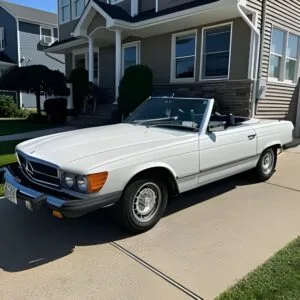 Mercedes-Benz 1978 — Classic in excellent condition.33,500 €
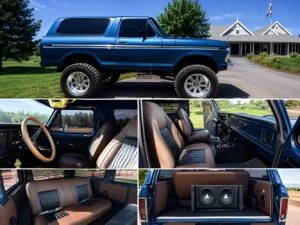 1978 Ford Bronco — 351 M400 engine, raised suspension, 5-speed manual transmission, 4x466,000 €
 MG Midget 1977 — Convertible, running, in good condition.€19,000
 Chevrolet El Camino 1977 — Project with good bodywork and a 350 V8 engine.€17,000
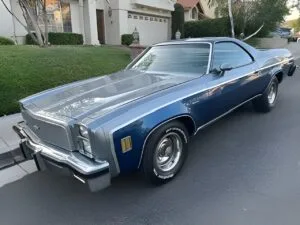 Chevrolet El Camino Classic 1977 — Complete restoration, 350 V8 engine, air conditioning€33,000
View all stock · Can't find the model? We'll look for it for you.