


Registering an American Car in Germany (and Bringing it to Portugal): Guide 2026
Importing a car directly from the USA to Portugal It can be fiscally burdensome — especially for recent vehicles with high emissions. Therefore, many European importers opt for... enroll first in another European Union country, where the tax burden is lower, and only then transfer the vehicle to Portugal as an intra-community vehicle — thus benefiting from the age reduction in the ISV (Vehicle Tax).
Germany is one of those options: no registration fee, Reduced VAT for classic cars and a well-recognized historic status (H-Kennzeichen) throughout Europe. The trade-off is a demanding and detailed technical approval (TÜV), which can stall or increase the cost of the process if the car is not in impeccable condition.
In this guide we explain how the process works, how much it costs (indicative values 2026 — confirm with your agent) and when Germany is more cost-effective than registering directly in Portugal.
Complementary guide: Importing a Car from the USA to Portugal — A Complete Guide
How much does it cost to enroll in school in Germany?
One of Germany's great advantages is that It doesn't exist.Unlike Portugal (ISV), Spain (Matriculation Tax) or other EU countries, Germany There is no registration fee.. The tax cost at the time of registration is minimal.
The cost components are:
| Item | Indicative value 2026 |
|---|---|
| Customs duties (code 8703, via EU) | 10 % regarding the declared value |
| VAT (Mehrwertsteuerstandard | 19 % |
| VAT — collector vehicles (NC 9705, ≥30 years) | 7 % |
| Registration fee (Zulassung) | ~86 € |
| Vollgutachten §21 StVZO (TÜV/DEKRA approval) | ~600 € (I estimated) |
| Kfz-Steuer (annual circulation tax) | variable by engine displacement/emissions |
Note: Indicative values. The listed customs duties apply to passenger cars 8703. For pickups 8704 (goods), the rate rises to 22 %. Always confirm with a customs broker.
For an American classic 30 years old or more classified as a collector's item (tariff code) HS Code 9705):
- Customs duties: 0 % (EU collection regime)
- VAT: 7 % (German reduced rate for collectibles)
This combination — no registration tax and reduced VAT for classic cars — makes Germany particularly attractive for muscle cars and Detroit classics.
Classical Regimen: the H-Kennzeichen
The German equivalent of the collection system is the H-Kennzeichen (historical registration), recognizable by the letter "H" at the end of the plate — for example, CA-ZZ-123 H.
To obtain it, the vehicle must cumulatively meet the following requirements:
- 30 years or older age (from the date of manufacture).
- Original state preserved — without significant structural modifications.
- Approval in a expert report §23 StVZO performed by a TÜV or DEKRA expert, who certifies the authenticity and state of preservation.
The tax advantages are significant:
- Kfz-Steuer (circulation tax) goes to a reduced fixed pass (~€191/year), regardless of engine size or emissions — a considerable saving for an American V8.
- The "H" plate immediately conveys classic car status when the car is later driven or resold in Portugal.
For those intending to bring the vehicle to Portugal, the H-Kennzeichen is an excellent passport: the vehicle is already circulating as a documented classic car registered by an independent technical authority (TÜV/DEKRA), which facilitates its reclassification as a collector's item at the Portuguese IMT (Institute for Mobility and Transport).
TÜV §21 StVZO Approval: The Step That Defines Everything
An American car sold in the USA does not have COC (European Certificate of Conformity). To legally drive in Germany — and obtain a license plate — you need to pass a test. Full expert analysis (Vollgutachten) under §21 of the StVZO, carried out by a TÜV or DEKRA technical inspector.
Vollgutachten assesses the entire structure, security systems, lighting, and compliance with European standards. The estimated cost is around... ~600 €, However, it can vary depending on the inspector and the complexity of the vehicle.
What is typically required or adapted:
- Conversion of headlights to European standard (beam to the right of the lane).
- Changes to the taillights and hazard lights (amber vs. red in the US).
- Verification of the braking and steering system according to ECE standards.
- Adapting the odometer/speedometer to km/h.
The Vollgutachten It's not just a stamp.The inspector may refuse approval or require additional modifications if non-conformities are found. Therefore, before shipping the car from the USA, it is advisable to verify the model's homologation with a specialist.
Warning: Salvage Titles
Germany not prohibited by law the importation of vehicles with American salvage titles, as opposed to France or Spain. However, the presence of a salvage title triggers a enhanced technical inspection within the scope of Vollgutachten §21 — more time-consuming and more expensive.
One Certificate of Destruction (COD) in the US is a different case: it means that the vehicle has been declared unrecoverable by the insurance company and It cannot be legalized. — TÜV will refuse approval. Do not confuse with salvage title (recoverable) and Certificate of Destruction (unrecoverable).
If the vehicle has a history of accidents, document all repairs before the TÜV inspection. Transparency is the best strategy.
Germany vs Portugal: Is it worth it?
The central question is always the same: Would it be worthwhile to enroll in a German university and then transfer to Portugal?
The answer depends on the type of vehicle and your plans:
| Scenario | Conclusion |
|---|---|
| Classic car ≥30 years old, state of origin | Attractive Germany — rights 0 %, VAT 7 %, H-Kennzeichen recognized; then transfers to PT benefiting from ISV reduction due to age. |
| New car, high emissions, wants to drive in Portugal. | First, analyze the ISV in PT. Registering in Germany delays but does not eliminate the Portuguese ISV (Vehicle Tax) upon transfer. |
| Salvage title | Possible in Germany, but inspection is more expensive; approval is not guaranteed. |
| Pickup 8704 | Customs duty 22 % in any EU country; analyze total cost. |
Strengths of Germany:
- No registration tax (immediate savings vs. Portugal/Spain).
- VAT 7 % for classic cars (vs 23 % in PT for a direct import).
- H-Kennzeichen is widely recognized as proof of historical status.
- Mature classic car market — easy to find TÜV specialists with experience in American cars.
Points to consider:
- Vollgutachten §21 mandatory and demanding (~€600 + possible adaptations).
- Kfz-Steuer annual (despite the reduced forfait in H).
- Additional logistics: the car needs to enter Germany before continuing on to Portugal.
- Requires a customs broker with specific experience in the German process.
Germany is particularly suitable for those who want a well-documented classic, with independent technical expertise, intended for discerning collectors or B2B resale.
Do you want a simulation for your specific case?
Each vehicle is a different case. Before buying a car in the US, we conduct a complete analysis: customs classification, taxes by country, homologation, and total cost — so there are no surprises.
Contact us on WhatsApp And tell us the year, model, and estimated value.
Or explore our stock of American classics already in Portugal: View available cars.
Frequently Asked Questions
Does Germany have a registration tax for cars imported from the USA? No. Germany does not have an equivalent to the Portuguese ISV or the Spanish Impuesto de Matriculación. The registration cost is an administrative fee of approximately €86 (ZulassungYes, there is the Kfz-Steuer — an annual road tax, calculated based on engine displacement and emissions (or a fixed fee for H-Kennzeichen vehicles).
What is Vollgutachten §21? This is the mandatory technical inspection required to legalize a vehicle without a European Certificate of Conformity (the typical case is an American car). Performed by a TÜV or DEKRA inspector, it covers all aspects of the vehicle's safety and compliance. The estimated cost is approximately €600 — but this can vary. Without this approval, there is no German registration.
Is the H-Kennzeichen valid in Portugal? Yes. A vehicle with a German H-Kennzeichen (vehicle registration number) is recognized as a historic vehicle in the EU. To circulate in Portugal, it needs to be transferred (new Portuguese registration) or circulate with a foreign registration within the legal deadlines. When transferring to Portugal, the classic car status facilitates reclassification at the IMT (Portuguese Institute for Mobility and Transport).
Can I import a salvage title into Germany? Legally it is possible, but TÜV §21 includes enhanced inspection, which is more time-consuming and potentially more expensive. A Certificate of Destruction (COD) is definitively refused. Document all repairs before the inspection.
How long does it take to enroll in school in Germany? This varies depending on the availability of the TÜV inspector and any necessary adaptations. Allow at least 4 to 8 weeks after the car arrives in Germany, not including shipping time from the USA.
We already have these in stock.
Public prices, with and without Portuguese registration.
 MG MGB 1978 — Runs and drives without any rust.15,500 €
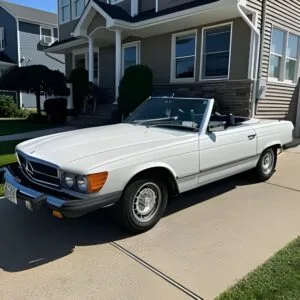 Mercedes-Benz 1978 — Classic in excellent condition.33,500 €
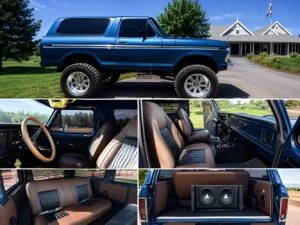 1978 Ford Bronco — 351 M400 engine, raised suspension, 5-speed manual transmission, 4x466,000 €
 MG Midget 1977 — Convertible, running, in good condition.€19,000
 Chevrolet El Camino 1977 — Project with good bodywork and a 350 V8 engine.€17,000
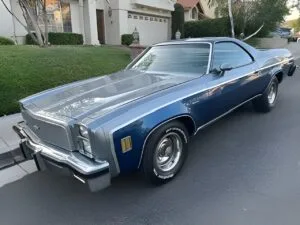 Chevrolet El Camino Classic 1977 — Complete restoration, 350 V8 engine, air conditioning€33,000
View all stock · Can't find the model? We'll look for it for you.