


Importing a Car from the U.S. to Portugal: The Complete Guide (2026)
Importing a car from the United States to Portugal can be a great deal—an American classic, a muscle car, a pickup truck—but it can also turn into a financial nightmare if you don't know exactly what you'll pay and what could go wrong. There is little reliable, up-to-date information on this topic, especially in Portuguese. This guide brings together everything we've learned in the field, with an American dealer's license and hundreds of imported vehicles.
In summary: The cost of importing isn't just «the price of the car + shipping.» It's the price + customs + ISV + VAT + type approval + IUC. And for newer, high-displacement cars, the Portuguese ISV (based on CO₂) can be exorbitant—sometimes even more expensive than the car itself. Throughout this guide, we’ll show you how to avoid this pitfall.
Why import a car from the U.S.?
The U.S. market offers what Europe doesn't: muscle cars, Detroit classics, full-size pickups, models that were never sold here, and purchase prices that are often lower. For dealers and collectors, the profit margin is there — as long as you do the math carefully before buying, not later.
There are, however, two structural differences compared to a car purchased in the EU:
- Mandatory maritime transport (There is no overland route from the U.S.), with costs varying widely between the East Coast and the West Coast.
- Approval: Many American cars do not have European type approval (COC), and some versions have specifications that differ from those in Europe—which can complicate matters or even make it impossible its legalization.
How much does it cost? The components of the cost
The total cost of importing a car from the U.S. to Portugal is broken down into three categories.
1. Taxes and fees (the surprising part)
- Customs duties: 10 % on the value for a light passenger car (tariff code 8703). For a cargo vehicle/pickup classified under 8704, it rises to 22 %. (Note: The exact tariff depends on the customs classification—check with a customs broker.)
- VAT: 23 % on the value plus customs duties. For a direct import from the U.S. (a third country), VAT is always as required.
- ISV (Vehicle Tax): the Portuguese tuition rate. Calculated based on the displacement and, above all, about the CO₂ emissions. This is where American cars really get hit hard: they tend to emit more CO₂ than their European counterparts, and the ISV is highly progressive. For direct imports from the U.S., there is no age-based deduction (The discount for used cars applies only to vehicles already registered in the EU.).
- IUC (Single Vehicle Tax): annual tax, due upon registration (payable on 90 days (following the issuance of the registration).
2. Transportation and customs clearance
Shipping costs depend on the port of origin (East Coast vs. West Coast), the weight of the car, and the carrier. Added to this are customs clearance and the DAV (Vehicle Customs Declaration), which is submitted to the Tax Authority.
3. Vehicle Registration and Bureaucracy in Portugal
Inspection (IPO), certification (national by the IMT, or European via the COC), registration, license plates, and vehicle registration. For a car without a European COC—typically an American car—the following is required: Individual approval at the IMT, which can be technical and time-consuming.
The «classic» plan: the major advantage of the 30+ years plan
Here's the best news for anyone who imports classic cars. A vehicle with 30 years or older, in its original condition and a model no longer in production, can be classified as collectible (tariff code 9705). This system, common to the entire European Union, offers two huge advantages:
- Customs duties at 0 % (instead of 10 %).
- ISV calculated based solely on engine displacement (excluding the CO₂ component, which accounts for the largest share).
That is why the overwhelming majority of Autozilla vehicles are classics from 30+ years ago: the tax framework is much more favorable. (The 9705 tariff classification is subject to case-by-case confirmation by the customs broker.)
The pitfall to avoid: recent large-engine cars
If you import a car recent (under 30 years old) and imported directly from the U.S. for registration in Portugal, the CO₂-based ISV can skyrocket to five-digit figures—in extreme cases, more expensive than the car. Portugal is one of the EU countries that imposes the highest CO₂ taxes.
There is a legal way to reduce this bill: enroll first in another EU country (which incurs lower CO₂ taxes) and only then import the vehicle into Portugal as a used vehicle from within the EU—thereby benefiting from the age-based tax deduction. This is exactly the analysis «where to enroll»which we do before each import. Each country has its own rules:"
- Belgium e France: Reduced VAT for classic cars (6 % and 5.5 %), low registration fees → often the most economical option.
- Germany, Netherlands, Poland, Spain, Italy: Each has its own plan and annual fees.
- Attention, Poland: the tax excise tax It's due right at customs clearance, even before registration.
- Be aware of «salvage» securities: France and Spain refuse; Poland and Belgium are more flexible.
→ See also the specific details for enroll in Portugal or Contact Us for a customized simulation.
Step-by-Step Guide to Importing
- Check the certification on the IMT website Before you buy (chnac.imt-ip.pt). If the model cannot be approved, the deal won't move forward—it's the first «yes or no.».
- Simulate all taxes based on the model year, engine displacement, and emissions.
- Request shipping quotes (customs duties included) and contact a customs broker.
- Add it all up (steps 2 and 3) and confirm whether the deal is still worth it.
- After arrival: get the approval number at the IMT.
- Do the inspection (IPO) at an authorized center.
- Fill out the DAV (Vehicle Customs Declaration) at customs.
- Pay the ISV and VAT → Then you can ask for the registration.
- Take care of the safe and the IMT Form 9.
- Take the vehicle registration (Registry Office or Automóvel Online).
- Pay the IUC up to 90 days after enrollment.
Mistakes and Fraud to Avoid
Be wary of deals that are «too good to be true.» Always check the vehicle’s history (total loss, accidents, mileage). before to pay. Be sure to factor in the euro-to-dollar exchange rate when budgeting. And remember: the cost of mechanical modifications (headlights, turn signals, etc.) is not included in the taxes and can amount to hundreds of euros.
Why Autozilla?
We operate directly from California with a U.S. dealer license. Our vehicles are shipped to Portugal legally cleared through customs, with all documentation in order, ready for B2B resale. We perform a complete tax analysis before for each purchase—including the best country of entry into the EU—so there are no surprises.
Want to import an American car safely?
Contact us on WhatsApp or see the our inventory in Portugal.
Frequently Asked Questions (FAQ)
How much does it cost to import a car from the U.S. to Portugal? It depends on the value, engine displacement, CO₂ emissions, and age. For a classic car (30+ years old), the collection program significantly reduces the bill (customs duty 0 %, ISV based only on engine displacement). For a recent, high-performance car, the ISV linked to CO₂ emissions can be very high. Request a customized estimate.
Do classic cars pay less in taxes? Yes. Vehicles that are 30+ years old and imported from their country of origin are classified as collectibles (9705): customs duties are 0, and the % and ISV taxes are calculated based solely on engine displacement, without the CO₂ component.
Do I have to pay VAT when importing from the U.S.? Yes. For a direct import from a third country (the U.S.), the 23 % VAT is always due on the value plus customs duties.
Can I import a car with a «salvage» title? In Portugal, it is possible but requires a lot of effort (individual approval). In France and Spain, it is, in practice, not allowed. Poland and Belgium are more flexible.
How long does it take? Expect it to take several weeks to several months, mainly due to shipping logistics and individual approval by the IMT.
We already have these in stock.
Public prices, with and without Portuguese registration.
 MG MGB 1978 — Runs and drives without any rust.15,500 €
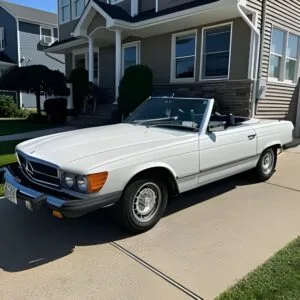 Mercedes-Benz 1978 — Classic in excellent condition.33,500 €
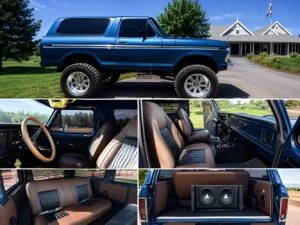 1978 Ford Bronco — 351 M400 engine, raised suspension, 5-speed manual transmission, 4x466,000 €
 MG Midget 1977 — Convertible, running, in good condition.€19,000
 Chevrolet El Camino 1977 — Project with good bodywork and a 350 V8 engine.€17,000
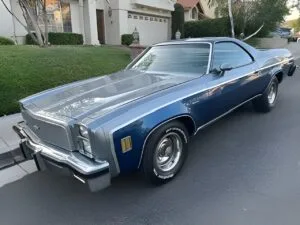 Chevrolet El Camino Classic 1977 — Complete restoration, 350 V8 engine, air conditioning€33,000
View all stock · Can't find the model? We'll look for it for you.