


Importing a Car from the USA Directly to Portugal: Tax Details (2026)
Portugal is the final destination — but it's not always the best entry point. For resellers and collectors who import directly from the United States, the details of the ISV (Vehicle Tax), individual homologation, and collection regime can be the difference between a healthy profit margin and a disastrous business.
This guide delves deeper into what the General guide to importing from the USA It provides a concise overview, focusing exclusively on the specific taxes, rules, and risks of enrolling in a university in Portugal.
Notice: all values are 2026 indicators. The ISV (Vehicle Tax) tables, the conditions of the collection regime, and the rules for individual homologation are subject to updates — always confirm with an accredited customs broker before making any purchase decision.
How much does it cost to import a car from the USA to Portugal?
The tax cost of registering a vehicle in Portugal is divided into four layers. There will be no surprises if you are aware of them before making the purchase.
Customs Duties
Duties are charged upon entry into the European Union, regardless of whether it is Portugal or another member state.
- Passenger car (NC 8703): 10 % Regarding the CIF value (cost of the car + insurance + sea freight).
- Goods vehicle / pickup (NC 8704): 22 %.
- Collector's item ≥ 30 years old (NC 9705): 0 % — the most immediate advantage of the classical regime.
Tariff classification is not automatic. The customs broker verifies the vehicle's technical specifications and age documentation; any questions regarding classification must be resolved with a binding information request to customs before importation.
VAT — 23 % (always)
In a direct import from a third country such as the USA, the VAT of 23 % is always Due, calculated on the customs value plus duties. There is no possible exemption based on the vehicle's condition, age, or declared use.
This is where Portugal differs negatively from countries like... Belgium (6 % for classic NC 9705) or a France (5.5 %): In Portugal, VAT is 23 % regardless of the vehicle classification.
ISV — the component that decides everything.
ISV (Imposto Sobre Veículos) is the Portuguese vehicle registration tax. It is calculated on... two components:
- Displacement component: progressive scales per cm³.
- CO₂ component: Highly progressive. Above 180 g/km (NEDC cycle), each additional gram weighs disproportionately.
The critical factor for direct imports from the USA: when the car no prior registration at the EU, the ISV is calculated without any reduction for age — as if it were brand new. A recent American V8, with emissions typically between 300 and 450 g/km equivalent NEDC, can generate a five-figure ISV (Vehicle Tax) — sometimes exceeding the car's market value itself. Portugal is one of the EU countries that most heavily penalizes CO₂ emissions.
Rule of thumb: If the estimated ISV exceeds 40–50 % of the car's value, seriously consider the alternative route (see section below).
IUC — Single Circulation Tax
The IUC is paid annually and must be settled. within the following 90 days to the issuance of the Portuguese license plate.
- Automatic exemption: vehicles whose first registration (in any country) is prior to January 1, 1981.
- Classics released after 1981: not automatically exempt, but may be certified as Vehicles of Historical Interest (VIH) Next to the Automobile Museum (Caramulo) or the ACP. HIV certification allows access to a significant reduction or exemption from the IUC (Vehicle Tax). The process involves a technical inspection and documentation of authenticity and origin status.
Classic Regime ≥ 30 Years: NC 9705
For vehicles with 30 years or older, For vehicles in their original state (or with reversible interventions using original parts) and whose model is no longer in production, the tariff code applies. NC 9705 — collector's item. It is a harmonized European system, applicable in any member country of entry.
The advantages in Portugal are cumulative:
| Tax | Standard regime | NC 9705 Regime |
|---|---|---|
| Customs duties | 10 % (8703) | 0 % |
| ISV — CO₂ component | Applicable | Not applicable |
| ISV — cylinder capacity component | Applicable (Table A) | Applicable (collection table) |
| VAT | 23 % | 23 % (no reduction in PT) |
The ISV (Vehicle Tax) applies only to engine displacement according to a specific table for collector cars — a very significant saving on an American V8. The elimination of the CO₂ component is what makes classic cars 30+ years old the heart of the import business to Portugal.
Conditions to be confirmed with the customs broker:
- Condition and authenticity: relevant non-original parts may compromise NC 9705 classification.
- Documentation of origin: US title, factory certificate or equivalent proving the year and model.
- The classification is confirmed on a case-by-case basis by Portuguese customs at the time of dispatch — it is not automatically guaranteed by the age of the vehicle.
IMT Approval: The "Yes or No" Question Before Buying
American cars do not have a European Certificate of Conformity (COC). To register them in Portugal, this is mandatory. individual approval Issued by IMT (Institute for Mobility and Transport).
Verification is required before any payment:
- Access chnac.imt-ip.pt and research the vehicle's make and year.
- If the model already has a precedent for individual homologation in Portugal, the process is faster.
- If it is not listed, contact IMT or a qualified technician: it is possible to submit an application for technical tests, but it can take months and have variable costs.
Situations that pose a risk of refusal:
- Models with passive safety specifications that differ from European ECE standards (impact absorption structure, airbags with different calibrations).
- American versions of models sold in Europe, but with structural differences documented in the type approval process.
- Vehicles with significant non-original modifications that alter their technical identity.
If the IMT refuses individual homologation, the car no registration in Portugal — and there is no expedited appeal. This verification is not optional.
Salvage: Possible, but conditional.
Importing a car with title to Portugal salvage (total loss declared by US insurance company) is legally possible, But the journey is more demanding and the outcome uncertain.
- Individual approval is subject to analysis of the structural damage report.
- Deformations in safety zones (longitudinal members, A/B/C pillars, front or rear absorption zone) may lead to rejection by the IMT (Portuguese Institute for Mobility and Transport).
- The process involves a more in-depth technical inspection and usually additional expert assessment, increasing the overall cost.
In contrast, France e Spain In practice, they reject the titles. salvage. Belgium e Poland They are more flexible — which explains why some operators opt for these entrances for vehicles with this type of permit. "More flexible" does not mean "guaranteed": the final decision always rests with the local technical control center.
Is it worth enrolling in Portugal or entering through the EU?
This is the central question for any car. recent (less than 30 years old) with large engine displacement or high emissions.
Enrolling directly in Portugal is the simplest option when:
- The vehicle is 30+ years old and falls under the NC 9705 regime — with no CO₂ component in the ISV (Vehicle Tax), the bill is manageable.
- CO₂ emissions are moderate (typically below 130–150 g/km), making the standard ISV bearable.
- The vehicle was first registered before 1981 and benefits from automatic exemption from road tax.
Consider entering through another EU country when:
- The car is new and powerful, but with high CO₂ emissions: the ISV (Vehicle Tax) without a reduction could be prohibitive in Portugal.
- The strategy is to register the vehicle first in another EU country, use it there for a period, and only then transfer it to Portugal as a registered vehicle. used within the community — thus benefiting from discount based on registration seniority in the ISV (Vehicle Tax), which does not exist in direct imports from the USA.
This route is legal and follows the rules of the European internal market. It requires planning, proper documentation, and a partner in the country of entry. The most commonly used countries for this route are:
- Belgium: VAT 6 % for classic NC 9705, BIV calculated by engine displacement (excluding CO₂), flexibility with salvage.
- France: VAT 5.5 % for classic cars; more restrictive with salvage.
- Others: Germany, Netherlands, Poland, Spain e Italy Each has its own registration fees and peculiarities — none is universally better.
The "where to enter the EU" analysis is part of the Autozilla process for each vehicle. There is no single answer: it depends on the year, engine size, estimated emissions, title status, and the buyer's final destination.
Autozilla does this analysis for you.
Before each import, we calculate the total cost — ISV (Vehicle Tax), VAT, customs, estimated IUC (Road Tax), homologation, EU route vs. direct route — so there are no surprises upon arrival. We work with a US dealer license in California. The vehicles arrive in Portugal with all the documentation in order, ready for B2B resale.
Contact us on WhatsApp Tell us the year, model, engine size, and title status, and we'll run a simulation before you buy.
See also: Complete guide to importing from the USA to Portugal. · Available stock
Frequently Asked Questions
Does Portugal charge reduced VAT on classic cars imported from the USA? No. Unlike Belgium (6 %) or France (5.5 %), Portugal applies VAT of 23 % to all direct imports from third countries, including classic vehicles NC 9705. The tax benefit of the classic regime in Portugal lies in the exemption from customs duties (0 %) and the elimination of the CO₂ component of the ISV — but the VAT is always 23 %.
Does a 2010s Mustang V8 pay a lot in ISV (Vehicle Tax) in Portugal? Most likely, yes. A large-displacement V8 imported directly from the USA without prior EU registration pays ISV (Vehicle Tax) without any age reduction — five-digit values are common for emissions above 250–300 g/km. The ISV can exceed the market value of the car. Before buying, ask for a simulation with the real CO₂ and displacement values.
What is individual IMT homologation and when can it be refused? This is the process by which the IMT certifies that a vehicle without a European Certificate of Conformity (COC) meets the technical requirements to circulate in Portugal. It may be refused if the model has no homologated precedent and the American specifications diverge from ECE standards regarding passive safety. It can take weeks to months. Always check chnac.imt-ip.pt before buying — if the model is not listed, consult the IMT before making any payment.
We already have these in stock.
Public prices, with and without Portuguese registration.
 MG MGB 1978 — Runs and drives without any rust.15,500 €
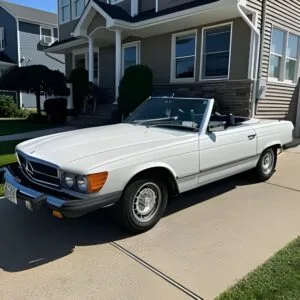 Mercedes-Benz 1978 — Classic in excellent condition.33,500 €
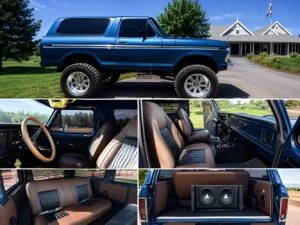 1978 Ford Bronco — 351 M400 engine, raised suspension, 5-speed manual transmission, 4x466,000 €
 MG Midget 1977 — Convertible, running, in good condition.€19,000
 Chevrolet El Camino 1977 — Project with good bodywork and a 350 V8 engine.€17,000
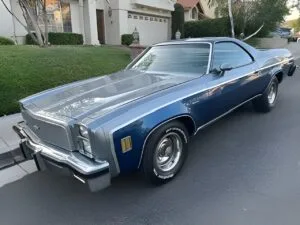 Chevrolet El Camino Classic 1977 — Complete restoration, 350 V8 engine, air conditioning€33,000
View all stock · Can't find the model? We'll look for it for you.