


Registering an American Car in France — and Then Bringing It to Portugal
France is, in most cases, The best gateway to the EU for American classics.. The French tax regime for collector vehicles combines customs duties at 0 %, the lowest collector VAT in the entire European Union (5.5 %), and exemption from ecological malus—a combination that does not exist in any other EU country. For those importing a classic car from the USA with a final destination of... Portugal, This route can save several thousand euros compared to direct import.
But there is one condition that admits no exception: The vehicle's title must be clean.. An American car with a title salvage (Accident, flood or theft) is absolutely refused in France — even if it is fully rebuilt and passes inspection. We will return to this point later.
How much does it cost to enroll in school in France?
The values below are 2026 indicators — always confirm with a licensed French customs broker., because the tax bases and procedures may change.
Customs duties
| tariff code | Vehicle type | Rate |
|---|---|---|
| 9705 (collection, 30+ years) | Classic in original condition. | 0 % |
| 8703 (passenger car) | Recent car | 6,5 % |
The classification as a collector's item (NC 9705) applies to vehicles with 30 years or older, in its original configuration and as a discontinued model. Validation is carried out by French customs, usually with an opinion from... FFVE (Fédération Française des Véhicules d'Époque).
VAT on entry
- Collection VAT: 5.5 % — the lowest reduced rate in the EU for collector vehicles, applicable under NC 9705 scheme.
- For recent vehicles (8703): Normal VAT of 20 %.
The VAT calculation basis is the value declared at customs plus customs duties. For a classic car classified under code 9705, the customs invoice at the border essentially boils down to: car value × 5.5 %.
Malus CO₂ (ecological tax on registration)
The French ecological malus may be very high For recent large-displacement cars, the progressive scales heavily penalize emissions above a certain threshold. However, Vehicles with a grey collector's license plate are exempt from malus.. This exemption is another decisive advantage for American classics.
Carte grise and other costs
- Carte grise (registration certificate): The cost varies by French region. In some regions, collector vehicles benefit from a reduced rate or exemption from the regional tax (regional tax on immatriculation certificates).
- Technical control (equivalent to the Portuguese IPO): mandatory before first registration.
- Customs broker fees and any individual homologation costs (for models without a European Certificate of Conformity).
Classic Regime: The Carte Grise Collection (via FFVE)
The collecting system in France works as follows:
- FFVE Certificate: The Fédération Française des Véhicules d'Époque issues a certificate recognizing the vehicle as a collector's item. This document is the starting point for customs classification NC 9705 and for the grey collector's card.
- Customs: With the FFVE certificate, the customs broker classifies the vehicle under NC 9705 → duties at 0 % and VAT at 5.5 %.
- Technical control: Mandatory technical inspection (there are specialized centers for classic cars).
- **Collection gray card (collection vehicle):** issued by the ANTS (Agence Nationale des Titres Sécurisés). With this registration, the car is legally allowed to circulate in France and, consequently, within the EU.
Attention: The collectible gray car may have usage restrictions in certain low-emission zones (ZFE). Check before planning to use the vehicle in Paris or other major French cities.
Beware of Salvage: Absolute Refusal in France
This point is critical and there are no known exceptions:
An American vehicle with a title salvage Regardless of the state of repair, it cannot be registered in France.**
The French system for controlling bonds does not recognize the American criteria for post-reconstruction.salvage. The French authorities do not accept the equivalent of rebuilt title North American as proof of fitness for driving. In practice, The attempt ends with the registration being refused., after already incurring transportation and customs clearance costs.
If the car you intend to import has any annotations of salvage in the history (verifiable via Carfax, AutoCheck or NMVTIS), France is not a viable option.. In that case, Poland e Belgium They have more flexible processes, but with different costs and constraints. Talk to us to evaluate the best alternative.
France vs Portugal: Is This Route Worth It?
The right question isn't "France or Portugal?" — it's "what's the cheapest total route for the specific vehicle I want?".
When France wins clearly
- Classic cars 30+ years old in original condition: The combination of 9705 + VAT 5.5 % + malus exemption is unbeatable. The cost of entry into the EU is minimal.
- Final destination: Portugal After obtaining the French carte grise, the car enters Portugal as used within the community, benefiting from age-related discount on Portuguese ISV (Vehicle Tax). In a classic car that's 30+ years old, the ISV (Vehicle Tax) applies only to the engine displacement (excluding CO₂ emissions), and the discount based on years of use further reduces the bill.
- Direct comparison: Importing the same classic car directly from the USA to Portugal implies customs duties of 10 % (instead of 0 %) and does not take advantage of the progressive scale of ISV reduction for intra-community used vehicles.
When direct Portugal can be an alternative
- Recent vehicles where the French tax would be zero (low emissions) but where the Portuguese ISV (Vehicle Tax) is also manageable — the direct route saves time and logistics.
- Vehicles that do not meet the FFVE criteria (modified, with significant replacement of original components).
Additional costs for the France route.
Registering a car in France involves an extra step: maritime transport to a French port (Le Havre is the most common), customs clearance costs in France, possible land transport to Portugal, and further bureaucratic procedures for re-registration in Portugal. These costs must be factored into the equation—sometimes representing an additional €500 to €1,500. Even so, for a classic car with significant market value, the tax savings often outweigh this extra expense.
Do you want to know if the France Route is worthwhile for you?
The answer depends on the year, the declared value, the emissions, and the status of the security. We run a complete simulation — France vs. direct import to Portugal — before each transaction.
Contact us on WhatsApp or see the our current stock.
Want to get a better understanding of the overall import picture? Check out our [reference/reference]. Complete guide: Importing a car from the USA to Portugal.
Frequently Asked Questions
Can any American classic be classified as a collector's item in France? Generally yes, provided the vehicle is 30 years old or more, is in a configuration close to its original state, and the model is no longer in production. FFVE evaluates each case individually. Extensive modifications or replacement of structural components may compromise the certification.
Does the 5.5% VAT rate apply to transport and other costs, or only to the value of the car? The VAT of 5.5% % applies to the customs value of the vehicle (purchase price + freight + transport insurance) plus customs duties. Customs broker fees and other services in France are taxed at the standard rate of 20% %.
After obtaining a French carte grise (student's license), is it easy to re-enroll in Portugal? Yes — a vehicle already registered in an EU member state enters Portugal as an intra-community vehicle, with a simpler process than direct import from the USA. It is necessary to present the DAV (Vehicle Declaration), pay the ISV (Vehicle Tax) (with a reduction for age) and have the vehicle inspected in Portugal. There are no new customs duties.
A car with salvage Can a vehicle repaired and inspected in the USA be registered in France?** No. The title salvage (even converted to rebuilt) is refused by the French registration authorities. There are no known exceptions, regardless of the vehicle's condition.
How long does the France–Portugal route take? Allow for sea transport (3 to 5 weeks from the East Coast, 4 to 6 from the West Coast), customs clearance and FFVE certificate (2 to 4 weeks), issuance of the carte grise (1 to 3 weeks) and re-registration in Portugal (2 to 4 weeks). In total, 3 to 4 months is a realistic timeframe.
Are the tax values indicated final? No — they are 2026 indicators. Tariff codes, VAT rates and FFVE procedures may be changed by European regulation or French legislation. Always confirm with an accredited customs broker before making any purchase decision.
We already have these in stock.
Public prices, with and without Portuguese registration.
 MG MGB 1978 — Runs and drives without any rust.15,500 €
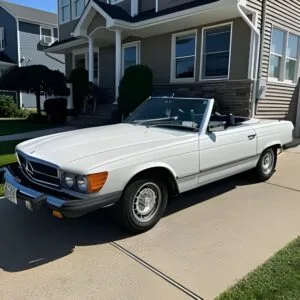 Mercedes-Benz 1978 — Classic in excellent condition.33,500 €
 1978 Ford Bronco — 351 M400 engine, raised suspension, 5-speed manual transmission, 4x466,000 €
 MG Midget 1977 — Convertible, running, in good condition.€19,000
 Chevrolet El Camino 1977 — Project with good bodywork and a 350 V8 engine.€17,000
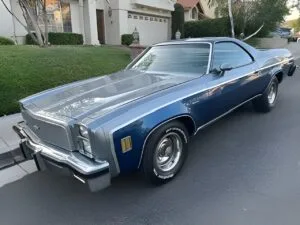 Chevrolet El Camino Classic 1977 — Complete restoration, 350 V8 engine, air conditioning€33,000
View all stock · Can't find the model? We'll look for it for you.